
Global Spare Parts Search
Stop searching, start finding
MRO data cleansing: Clean master data with just a few clicks
Clean MRO master data is the basis of effective and efficient maintenance processes. With data from thousands of original manufacturers and suppliers in one database and intelligent matching technologies, any material master can be analyzed for data enrichment, duplicates, and obsolescence within seconds.

How can master data be cleaned up easily?
Using SPARETECH, material master data cleansing becomes an easy process. In the first step, you upload your material master in the SPARETECH app, which analyses all material master fields and automatically identifies duplicates, incorrect or incomplete data sets, and discontinued materials. This happens with the help of SPARETECH’s intelligent matching algorithms, which match the data against a database covering tens of millions of original manufacturer data sets.
As a result, the master data can be cleansed from duplicates and obsolete parts, and enriched with 100% correct product data in a third step. With a direct Integration into ERP and CMMS systems like SAP and IBM Maximo, the gained master data cleansing insights can be applied seamlessly in the fourth and last step.
1. Analyze and enrich your master data with SPARETECH

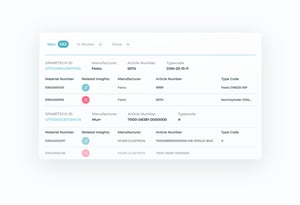
2. Identify duplicates in your master data
Removing duplicates from MRO master data is a complex, time-consuming task that requires clear governance and cross-team collaboration. It’s not a one-time fix but an ongoing process that depends on aligned standards and responsibilities.
Key considerations:
- Establish clear internal guidelines and a decision tree for identifying the leading material
- Map all dependencies and assess usage to ensure business continuity throughout the process
- Involve all relevant stakeholders early and maintain transparency at every step
- Document all decisions and changes made during the deduplication process
3. Enrichment with original manufacturer information
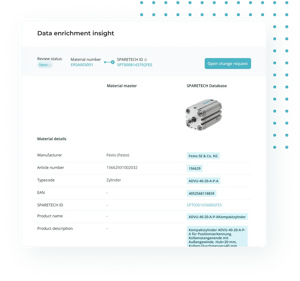
Improve your MRO master data quality by enriching incomplete or incorrect records with original manufacturer information. With SPARETECH, you can easily add missing details and correct faulty data using verified, standardized data sources, ensuring accuracy across all material master fields.
What you can enrich:
- Product names and descriptions
- Article numbers
- Type codes and technical specifications
- ECLASS IDs and classification data
- Any missing or incorrect master data fields
4. Ensure continuous data quality management
Many companies focus only on the initial cleansing of their master data, but without ongoing control, data quality quickly deteriorates. To maintain accurate and consistent MRO data, it’s essential to embed continuous checks into the material creation process and prevent duplicates or errors from re-entering the system.
Key actions for sustained data quality:
- Implement duplicate checks during new material creation
- Enforce data quality rules and mandatory fields
- Monitor and review new entries regularly
- Standardize material creation workflows
- Ensure clear ownership and accountability for data quality


How SPARETECH supports MRO data cleansing
- Completion with original manufacturer information for 100% data quality and orderability, e.g. by product names, product descriptions, EAN, article numbers, type codes, ECLASS IDs, etc.
- Addition of the current product status (active, discontinued) for reduced risks from obsolete spare parts (obsolescence management)
- Transparency of available suppliers thanks to access to the SPARETECH catalog
- Direct Interface to ERP System:
Apply changes through change requests directly to the existing material master via interface to your ERP System
FAQs
Why do duplicate materials get created in your systems (like SAP or IBM Maximo)?
Duplicate materials in SAP or IBM Maximo typically arise from a lack of standardization, incomplete data, and missing validation during material creation.
They often occur due to the following reasons:
- Inconsistent naming conventions: The same spare part is entered differently across plants or users (e.g., abbreviations, languages, or formatting variations).
- Missing or incomplete key identifiers: If fields like Manufacturer Part Number (MPN) or manufacturer name are not maintained, users cannot reliably check if a material already exists.
- Decentralized material creation: Multiple teams or locations create materials independently without a unified governance process.
- No duplicate check before creation: Without automated validation or search checks, users unknowingly recreate existing materials.
- Poor searchability in your current systems: Inconsistent descriptions or lack of structured data make it difficult to find existing materials, leading users to create new ones instead.
How do duplicate materials increase downtime risk, even when stock is available?
Duplicate materials increase downtime risk because they hide true stock levels across locations, making it difficult to find and use available spare parts when they are needed.
To reduce this risk, manufacturers should:
- Leverage software to identify and validate duplicates at scale: Use digital tools to detect duplicate materials based on multiple attributes, ensuring consistent validation and preventing duplicates from being created.
- Establish cross-site inventory visibility: Knowing what stock exists across all plants and storage locations ensures the right part can be located and used in time, avoiding unnecessary purchase
- Standardize on a single material: Redirect procurement to the validated material number and gradually phase out duplicates.
- Align maintenance planning: Ensure planners and technicians use the approved material number for future preventive maintenance jobs.
How should we handle discontinued spare parts?
You should identify affected assets, check for successors, and plan a controlled transition instead of immediately blocking procurement.
- Run a periodic check for End-of-Life (EOL) or Not Recommended for New Design (NRND) status on critical spares.
- Review technical specifications of suggested successor parts and let engineering confirm form-fit-function suitability.
- For high-risk items, evaluate a Last-Time-Buy (LTB) based on estimated remaining asset life.
- Update the material master with lifecycle status so buyers and planners see the risk before ordering.
See how to find the best suppliers for your MRO spare parts.
Why is it difficult to standardize spare parts data across multiple sites?
Standardizing spare parts data across multiple sites is difficult because data is typically fragmented across plants, systems, and teams, each using different naming conventions, structures, and processes.
In addition, many ERP and CMMS systems (e.g., SAP, IBM Maximo) were not designed to enforce global data standardization or advanced duplicate detection. As a result, inconsistencies are not systematically prevented and often accumulate over time.
Manual data cleansing does not scale in this environment. As new materials are continuously created, inconsistencies quickly reappear without a consistent, system-driven approach.
How can companies standardize spare parts data at scale?
To standardize spare parts data at scale, companies should:
- Define global data standards: Establish consistent rules for naming, descriptions, classification, and other attributes across all sites.
- Leverage software for automated matching and enrichment: Use digital tools to identify duplicates and harmonize materials based on multiple attributes.
- Centralize validation and decision logic: Ensure duplicate resolution, enrichment, and standardization follow the same rules across all locations.
- Enable cross-site visibility: Make materials and stock visible across plants to support consistent usage and reduce local variations.
- Embed governance through digital workflows: Use rule-based validation checks and role-based approvals to ensure consistent data creation, clear responsibilities, and prevention of new inconsistencies.
What is a realistic governance setup for duplicate-free material creation with a small team?
A lightweight approval workflow with clear responsibility for Manufacturer Part Number (MPN) validation is enough to prevent most new duplicates.
- Define one responsible role that checks new material requests against manufacturer data before release.
- Require mandatory fields such as manufacturer name and MPN for all externally sourced spare parts.
- Use a standardized template for material requests instead of free-text emails.
- Schedule a monthly review of newly created materials to catch patterns early.
How does poor MRO data impact spare parts availability and purchasing?
Poor MRO data reduces spare parts availability and disrupts purchasing because it makes it difficult to identify, locate, and order the correct parts.
When master data is incomplete, inconsistent, or duplicated, it leads to:
- Reduced parts availability: Spare parts may exist in stock but remain hidden due to duplicate materials or inconsistent records across plants and systems.
- Incorrect or delayed purchasing: Missing or unclear identifiers (e.g., MPN, manufacturer) make it harder to order the right part quickly and accurately.
- Unnecessary purchase orders: Lack of visibility into existing inventory leads to reordering parts that are already available elsewhere.
- Longer maintenance lead times: Technicians and planners spend more time searching for or verifying parts, delaying repairs.
- Higher inventory costs: Duplicate materials and excess safety stock increase working capital and storage complexity.
How do data cleansing and enrichment changes get applied back into SAP or other ERP systems?
Once duplicates are resolved and enrichment data is validated, changes can be pushed back into your ERP system through a direct API integration, not field-by-field manual updates. This means approved changes can be applied in controlled batches via structured change requests, keeping the process auditable and the risk of introducing new errors low.
Explore SPARETECH’s API solution for seamless integration.
Related to the topic
Get started today
SPARETECH is the fastest and most reliable way to reduce inventories and costs in spare parts management.