

Global Spare Parts Search
Stop searching, start finding





-min.jpg?width=300&name=Resources_Menu%20(3)-min.jpg)




Key takeaways
Master Data Governance (MDG) is a business-critical capability: It defines the rules, roles, and workflows needed to keep spare parts data accurate, consistent, and usable across systems and teams.
Poor data quality drives operational inefficiencies: Duplicate entries, missing data, and inconsistent naming lead to maintenance delays, excess inventory, sourcing errors, and rising MRO costs.
Strong MDG delivers measurable business value: Companies benefit from reduced inventory, more efficient procurement, improved decision-making, and significant workflow efficiency gains.
Effective MDG requires structured governance, not just tools: Success depends on clear data ownership, enforced data standards, defined workflows, and cross-functional collaboration supported by technology.
What is Master Data Governance (MDG)?
Manufacturers today rely on vast networks of parts, systems, and suppliers — all connected by one critical element: data. But when material master data is inconsistent or poorly managed, operations slow down and costs rise.
Duplicate entries. Missing attributes. Conflicting descriptions. These are not just data issues — they’re operational risks that show up in maintenance delays, excess inventory, and sourcing errors.
Master Data Governance (MDG) applied in Maintenance, Repair and Operations (MRO) is the combination of rules, roles, and workflows that ensure master data — such as spare parts data — is accurate, complete, and consistent across systems, plants, and teams.
When maintenance, procurement, or operations teams face inefficiencies, the root cause is often not the software itself, but the poor quality and lack of governance of the underlying master data. That's why MDG has become a business-critical capability in today's landscape.
The real cost of bad data
The impact of poor Master Data Governance within MRO is rarely visible in a dashboard, but it shows up everywhere:
- A technician can’t find a part in SAP because it's named differently in another plant.
- Procurement buys a component already in stock because it’s duplicated under another ID.
- A critical part fails, but the replacement is delayed because the part is obsolete and there is no record of the successor product.
According to SPARETECH’s industry data:
- Over 40% of MRO inventory has not been used in 5 years.
- A large portion of material masters are still created and managed manually, leading to inconsistent quality.
- Year-over-year MRO spend continues to rise, often driven by data-related inefficiencies.
And the costs are cumulative: overstocked warehouses, longer downtime, increased supplier spend, and lower trust in internal systems. Bad data creates friction at every step — and it scales with every new site, plant, or system added.
Business benefits of effective Master Data Governance
Investing in robust MDG processes delivers clear value — especially in the context of MRO (Maintenance, Repair and Operations), where duplicate parts, inconsistent naming, and data silos cause operational drag and hidden costs. Here are some of the key benefits of implementing a strong MDG framework.
Inventory optimization
One of the most immediate impacts of effective Master Data Governance is spare parts inventory reduction. By identifying and eliminating duplicates or obsolete items, organizations can consolidate material records and reduce unnecessary stock levels. This frees up warehouse space and releases working capital tied up in unused inventory.
💡 Case Study: Idahoan Foods
Idahoan Foods achieved up to 50% inventory reduction of common parts across multiple sites through cross-plant data standardization and duplicate detection.
Smarter, more efficient procurement
Procurement teams benefit from standardized, searchable data. With trusted part descriptions, harmonized attributes and transparency of available suppliers buyers can avoid rogue purchases, identify cost-effective alternatives, and reduce reliance on single-source vendors. This leads directly to measurable procurement cost savings, accelerated sourcing, and reduced validation efforts.
💡 Case Study: ErlingKlinger
ErlingKlinger achieved €90K+ in procurement cost savings through better part identification.
Stronger decision-making with clean data
Effective Master Data Governance turns raw data into actionable insights—unlocking better analytics across maintenance and procurement. Whether you're benchmarking supplier terms, forecasting part usage, or driving strategic sourcing, a clean and standardized material master is essential, and can result in significant efficiency improvements.
💡 Case Study: Bosch
Bosch realized >50% efficiency gains in their material request workflows by automatically checking spare parts lists for new machines and production lines.
A foundation for digital transformation
AI tools, predictive maintenance platforms, and intelligent sourcing engines depend on clean, structured input. MDG ensures that foundational spare parts data is correct, complete, and aligned — enabling automation and system scalability.

Martin Weber, Co-Founder and CEO of SPARETECH, is a manufacturing and supply chain technology leader focused on transforming spare parts management through AI-powered MRO software. Before founding the company, he worked in industrial digitization at Porsche Consulting, supporting manufacturers in modernizing operations.
Expert tip: Without enforced MDG workflows, your ERP will continuously recreate duplicates and excess inventory
True governance doesn't sit in a policy doc. It should be enforced at every point of material creation, change and extension.
- Make MDG workflows mandatory for every new material (no bypass via emergency creation)
- Assign data ownership to operational teams (rather than IT), to ensure accountability, subject-matter expertise, and real-world data quality
- Embed duplicate detection directly into the creation process, not as a cleanup activity
- Actively monitor and flag discontinued parts, and keep successor data current in your ERP. Don't let an unplanned outage force the discovery
MDG only delivers value when it prevents bad data from entering, not when it tries to fix it later.
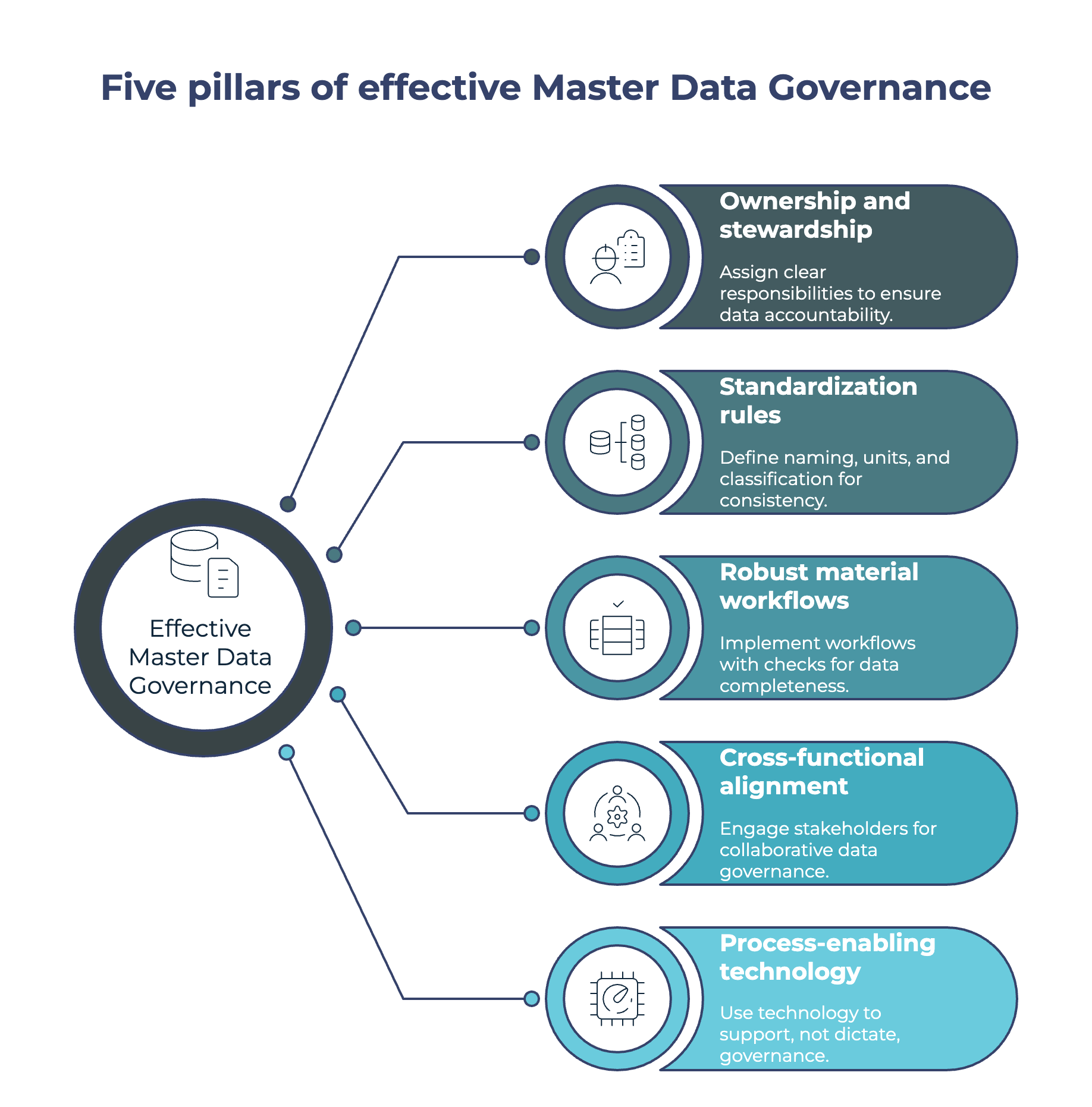
Five pillars of effective Master Data Governance
Master Data Governance is often misunderstood as a technical project or a software module. In reality, it’s a business capability that structures how critical data is created, maintained, and improved over time.
A mature MDG approach includes:
- Ownership and stewardship: Assign clear responsibilities to data owners — typically within maintenance, engineering, or supply chain roles. Without accountability, governance cannot be sustained.
- Standardization rules: Agree on material naming logic, unit conventions, required attributes, and classification structures. This provides consistency across sites and systems.
- Robust material workflows: Establish clear workflows for creating and maintaining material data. Include automated checks to prevent duplicates and ensure completeness, along with processes to update or phase out obsolete entries.
- Cross-functional alignment: Involve stakeholders from procurement, operations, and IT. MDG is not an isolated task; it’s a shared process.
- Process-enabling technology: MRO Software like SPARETECH can accelerate implementation, but governance must be defined first. Technology should enable, not dictate, your approach.
How to effectively implement Master Data Governance
Implementing Master Data Governance doesn’t require a massive system overhaul. A focused, step-by-step approach helps build trust in your data and demonstrate value early on. Here´s how to get started.
Step 1: Assess the current state of your material master
Start by evaluating the quality of your existing data. Key aspects to check include:
- Completeness: Are mandatory fields consistently filled?
- Accuracy: Are specifications and units of measure correct?
- Consistency: Are naming conventions and classifications standardized?
- Duplication: How many duplicate entries exist?
This assessment provides a baseline and helps identify one or two high-impact material groups — for example, frequently ordered parts or components tied to critical assets — to prioritize for cleanup.
Step 2: Establish governance processes
Once you've identified your focus areas, define clear data ownership and governance rules. This includes:
- Assigning roles and responsibilities (e.g., data stewards, approvers).
- Defining data quality standards and naming conventions.
- Setting up workflows for data creation, approval, and maintenance.
Use this phase to demonstrate early wins — such as reducing duplicated inventory or cutting sourcing time by 30%.
Step 3: Scale and sustain
As you expand MDG efforts, focus on change management. Long-term adoption depends on:
- Aligning stakeholders across departments or locations.
- Tracking KPIs (e.g., error rate reduction, time-to-create).
- Continuously improving governance processes based on feedback.
Future-proofing your MDG strategy
Once your governance process is running, the next challenge is scalability. MRO environments are becoming more complex, data-heavy, and interconnected. Here are three trends to consider:
- AI and automation: Intelligent duplicate detection, part equivalency suggestions, and attribute enrichment are becoming standard. But they require clean inputs.
- Integration with digital platforms: Governance must align with broader digital transformation initiatives, such as digital twins or predictive maintenance.
- Data volume and velocity: As machines, suppliers, and systems become more connected, the rate of data creation increases. Your MDG framework should scale with this complexity, not slow it down.
The best strategies anticipate growth and embed governance into day-to-day operations. That’s how you stay ahead, not just catch up.
Conclusion: Data-driven MRO starts with governance
Master Data Governance is often invisible, but its impact is everywhere. It determines how quickly a technician finds the right part, how confidently procurement negotiates a deal, and how smoothly your systems scale with change.
In an environment where uptime, efficiency, and digitization matter more than ever, governance is not a background task. It’s a strategic lever.
Before implementing new software or launching another transformation initiative, ask a simpler question:
Can we trust our data?
If the answer is no, that´s where to start.


Martin Weber, Co-Founder and CEO of SPARETECH, is a manufacturing and supply chain technology leader focused on transforming spare parts management through AI-powered MRO software. Before founding the company, he worked in industrial digitization at Porsche Consulting, supporting manufacturers in modernizing operations.
Expert tip: Without enforced MDG workflows, your ERP will continuously recreate duplicates and excess inventory
True governance doesn't sit in a policy doc. It should be enforced at every point of material creation, change and extension.
- Make MDG workflows mandatory for every new material (no bypass via emergency creation)
- Assign data ownership to operational teams (rather than IT), to ensure accountability, subject-matter expertise, and real-world data quality
- Embed duplicate detection directly into the creation process, not as a cleanup activity
- Actively monitor and flag discontinued parts, and keep successor data current in your ERP. Don't let an unplanned outage force the discovery
MDG only delivers value when it prevents bad data from entering, not when it tries to fix it later.