

Global Spare Parts Search
Stop searching, start finding





-min.jpg?width=300&name=Resources_Menu%20(3)-min.jpg)




Most organizations recognize that structured spare parts data is essential. Yet across most manufacturing organizations, descriptions vary by site, by team, and by whoever happened to create the record. The result: duplicates, procurement errors, and data that nobody fully trusts.
Today, we're launching Standardize, a new AI feature in SPARETECH software built to solve exactly this problem. It brings consistency to spare part descriptions across your entire organization, automatically and at scale.
What is Standardize?
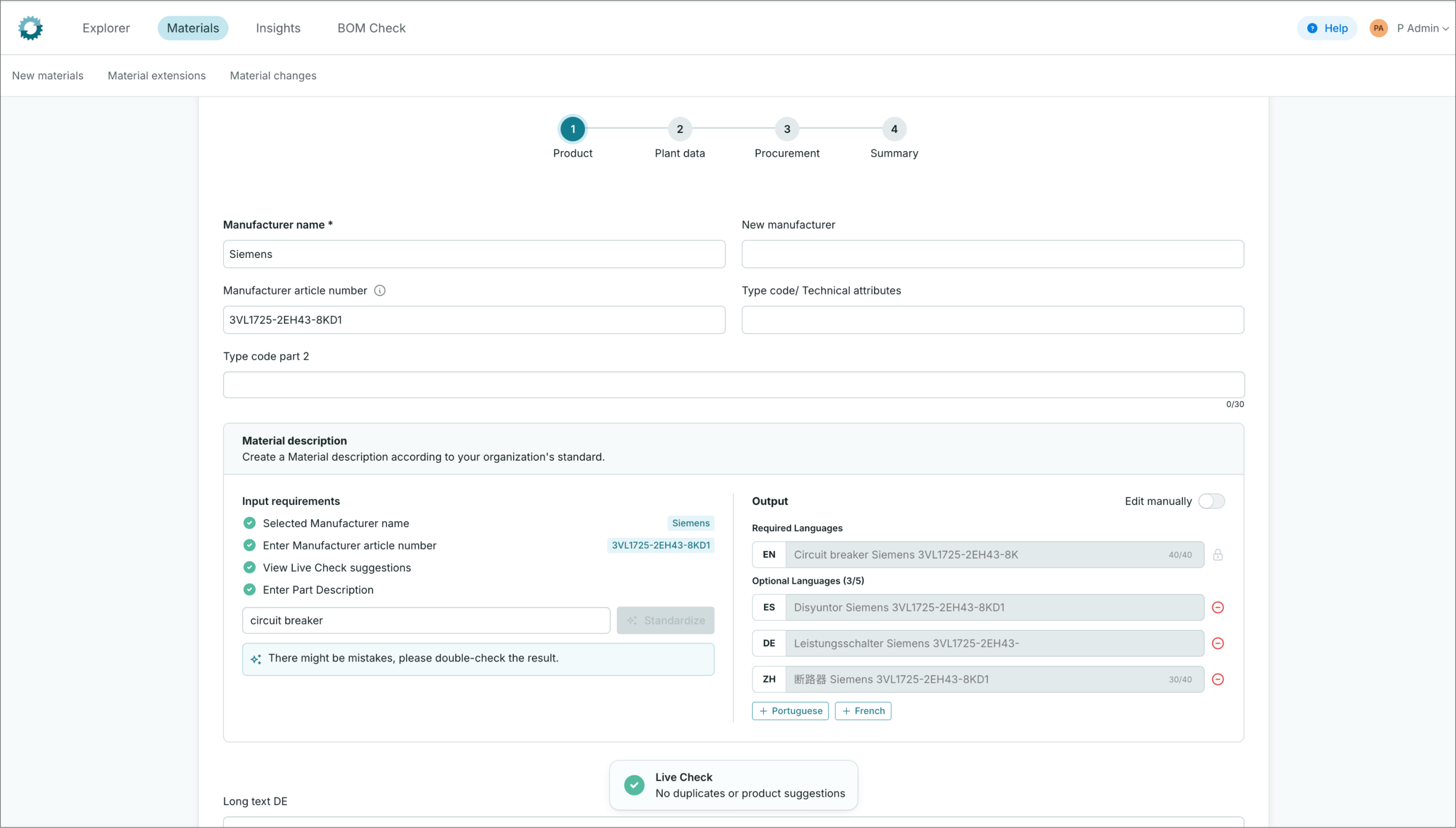
Standardize is an AI feature that generates structured, multilingual spare part short descriptions aligned with your organization’s data standards.
Instead of relying on each user to interpret naming rules in their own way, organizations can define their description logic once. Standardize then applies those rules across every relevant item, user, and plant.
The feature draws on SPARETECH’s global catalog of more than 40 million data sets, verified original manufacturer data, and user input to create descriptions that follow your defined structure. Built-in validation at every step and human review ensure that every description can be checked and adjusted before it is applied.
The challenge of standardizing spare part descriptions
Data standards don’t scale on their own
Most organizations have guidelines for how spare part descriptions should look: required attributes, naming conventions, a preferred order of information. The problem isn’t the guidelines. It’s what happens to them over time. Across thousands of items and dozens of contributors, rules get interpreted differently, required fields get skipped, and local abbreviations quietly become the norm. No single person makes a bad decision. But the cumulative effect is a data landscape where the standards exist in a document somewhere, and the actual records tell a different story.
Local language can create inconsistent data
Spare part descriptions often need to work across languages, especially when materials are created, reviewed, purchased, and used by teams in different countries. The description needs to keep the same meaning and structure, regardless of the language used.
Manual translation and local terminology can easily introduce variation. Different teams may use different words, abbreviations, or attribute formats for the same part, making it harder to compare data globally, consolidate demand, and analyze spend across sites.
Material master data creation takes too much effort
Building a proper material record, one that’s attribute-complete, correctly classified, and structured to your organization’s standards, isn’t a quick task. It typically involves multiple stakeholders and lots of back-and-forth between teams before anything is finalized. Multiply that across thousands of parts or a growing number of sites, and the administrative burden becomes significant. Time that could go toward analysis or decision-making gets spent on data entry instead.
How Standardize works
Standardize combines configurable rules, AI-generated descriptions, validation, and expert review inside SPARETECH’s Digital Workflow tool.
Define your description rules
Every organization has its own language of standardization, shaped by ERP constraints, internal conventions, and operational priorities. One company may require descriptions to follow a strict ERP character limit and start with a standardized noun. Another may prioritize manufacturer references for procurement clarity, while a third may structure descriptions around technical attributes to best support maintenance and inventory searches.
With Standardize, you can define this logic once, including the required attributes, order, length, and combination rules. Standardize then applies the same structure consistently across all spare parts, users, and sites, so descriptions follow your organization’s standards instead of depending on individual interpretation.
Validate at every stage, review before anything is applied
Standardize uses domain-specific AI models to accurately classify spare parts using an ECLASS-based classification structure. Validation runs at both the rule configuration stage and at description generation, catching issues early. Before any description is applied, users can review and adjust the output to make sure it meets their expectations.
Generate descriptions in multiple languages in one step
Standardize uses AI to generate structured spare part descriptions from verified original manufacturer data and user input. Descriptions can be created in multiple languages simultaneously, with no manual translation needed.
Embedded in your spare parts workflow
Standardize is built into the SPARETECH’s Digital Workflow, not added on top of it. Part creation, live duplicate checks, manufacturer data enrichment, and description generation all happen in one place, reducing handoffs and keeping data consistent from the start.
Getting started with your SPARETECH team
Getting started is straightforward. Reach out to the SPARETECH team and we will work with you to translate your organization’s data standards into Standardize rules, making sure the output reflects your conventions from day one.
What changes when spare part descriptions are standardized
One shared data foundation for every site and language
When spare part descriptions follow the same rules everywhere, teams across countries and plants are finally working from the same starting point. Parts are easier to find, duplicates are easier to spot, and data governance stops being a periodic cleanup project and becomes something that holds by default. Descriptions stay understandable in local languages without drifting from the defined standard.
Parts that are easier to identify, wherever you are
Standardized descriptions make it faster to identify and compare parts, whether you’re searching across systems or reading a printed label on the shop floor. That last point matters more than it might seem: in many manufacturing environments, the label is the primary reference. When it’s inconsistent or incomplete, making the right call becomes guesswork.
Clearer data for procurement and spend analysis
Consistent descriptions mean cleaner material records in your ERP. That translates to more accurate purchase order text, fewer mismatches at the point of ordering, and a much clearer picture of what you’re spending across sites and categories. For teams trying to consolidate suppliers or reduce maverick spend, that visibility is the starting point for every meaningful decision.
Standardization that scales with your organization
Spare part descriptions are a small detail with a large operational footprint. When they are inconsistent, the effects show up across procurement, maintenance, and inventory, often in ways that are hard to trace back to the source. Standardize gives organizations a way to get this right once, and keep it right at scale.