

Global Spare Parts Search
Stop searching, start finding





-min.jpg?width=300&name=Resources_Menu%20(3)-min.jpg)



.png?width=300&name=BOM_Self_Service_Header%20(1).png)
Key takeaways
More than half of manufacturers cannot see their spare parts across sites. 53% of the 362 manufacturing executives surveyed for the 2026 benchmark report no global visibility across their operations, and lack of transparency across sites has now topped the challenge ranking two years running.
The problem is structural, not organizational. 87% of these organizations are already centralized and 94% already have a dedicated master data team in some form, so what is missing is capability, not a reporting line.
Visibility is an output of part identification, not of system integration. Two plants with perfectly connected systems and two different descriptions of the same bearing have a dashboard, not visibility.
The first move costs nothing and takes a week. Pick one high-value part class, check manually whether it exists under more than one description across two plants, and the duplicate you find is your business case.
At one manufacturer, costs kept climbing and stock kept growing, and the assumption was that somebody was buying badly.
Leadership spent two years pointing at procurement.
I'd ask one question before blaming procurement: Can we actually see what we already own?
Martin Weber, CEO | SPARETECH
That question is harder to answer than it sounds. For most manufacturers, the honest answer is no.
What is spare parts inventory management?
Spare parts inventory management is the practice of identifying, classifying, stocking, and tracking the maintenance parts a manufacturer holds to keep production running. In multi-site operations it also means knowing that a part held at one plant is the same part held at another.
That second sentence is where the discipline separates from general inventory management, and it is what most guides skip.
Spare parts inventory management covers the parts a manufacturer holds to maintain and repair its own equipment, not the parts it sells. It differs from general inventory management because demand is driven by failure rather than by sales, which makes forecasting harder and makes availability more valuable than turnover. The field has its own academic literature for exactly this reason. Zhang, Huang, and Yuan's Spare Parts Inventory Management: A Literature Review, published in Sustainability in 2021, reviews 148 papers on spare parts inventory management from 2010 to 2020 alone. Spares are not a subcategory of retail stock control.
Spare parts sit inside the broader category of maintenance, repair, and operations (MRO), which also covers consumables, tooling, and the maintenance practices built around them. That umbrella is wide, and spare parts are a specific problem within it, with their own failure economics and their own data requirements.
Parts inventory management, service parts management, and spare parts management all get used for overlapping activities, and the boundaries matter less than the scope. In a single warehouse, a spare parts inventory is a list. Across 20 plants on three continents, it is a question of whether one physical component can be recognized in 20 different systems. Inventory visibility in supply chain contexts usually means tracking goods as they move toward a customer. Here, nothing is moving. The parts are already bought, already paid for, and already on shelves. Nobody can see them.
For the wider discipline, including classification, procurement, and lifecycle handling, see how spare parts management works end to end.
Why is the visibility gap manufacturing's number one challenge, two years running?
In SPARETECH's 2025 MRO strategy gap survey, operations leaders ranked lack of inventory visibility and transparency across sites as their single biggest challenge, at 45% (n=149). It beat unplanned machine downtime, excess stock, and stockouts.
A year later, the 2026 benchmark asked a different question of a different sample and found the same thing sitting underneath: 53% of respondents report no global visibility across their operations.
These are two separate measurements, not a trend line, and they should not be subtracted from one another. What they share is a ranking. Two consecutive years of research, two different instruments, and cross-site transparency comes out on top both times. That persistence is the finding. A problem that survives a year of being everyone's stated priority is not a problem of attention.
The market knows it, too. When asked what capabilities matter most in a spare parts solution, 36% of respondents in the 2025 survey named cross-site parts visibility in their top three, placing it third out of nine (n=300). Buyers want this. A year later, most still do not have it.
The gap is wider than the US data suggests
One regional wrinkle changes how a US reader should read all of this. American operations leaders do not rank visibility first. They rank the symptoms first.
| Challenge, operations leaders | United States (n=74) | DACH (n=75) |
|---|---|---|
| Lack of inventory visibility across sites | 34% | 56% |
| High capital tied up in excess stock | 38% | 27% |
| Critical spare parts stockouts | 35% | 28% |
Source: SPARETECH, The MRO strategy gap (2025), operations-side respondents, n=149. The US and DACH difference on inventory visibility is statistically significant.
In the US, excess stock and stockouts both outrank visibility. In DACH, visibility outranks everything by a wide margin. The same condition produces a different complaint depending on which side of the Atlantic the plant sits, and the American version names the two things visibility failure actually causes.
That ordering is the tell. Excess stock and stockouts are not separate problems competing with visibility for attention. They are what teams do once they stop trusting the underlying data and start compensating for it. Visibility sits upstream of both.
What the 2026 benchmark measured, and what 53% actually means
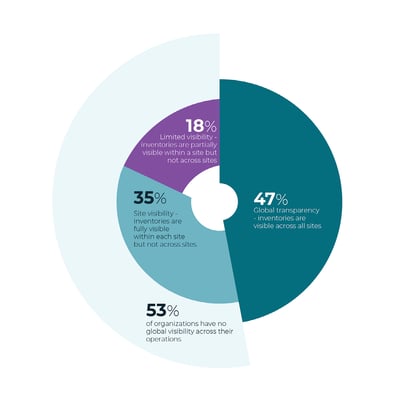
The 2026 benchmark surveyed 362 manufacturing executives across 12 countries in North America and Europe. Respondents were asked to describe the level of transparency they have over spare parts across their operations. The split:
- 47% report global transparency across sites
- 35% have visibility at site level only
- 18% have limited visibility even within a single site
The 53% headline is the second and third groups combined. It is not a satisfaction score or a maturity self-assessment. It is a description of what these organizations can and cannot see.
The full report is available in the 2026 benchmark report on spare parts management.
The three levels of spare parts visibility
The distinction that matters is not how good the reporting looks. It is how far the view extends, and what breaks at each boundary.
| Level | What it means | What it costs you |
|---|---|---|
| Global transparency (47%) | Every site can see what every other site holds, and records for the same part resolve to one item | Residual risk sits in data quality rather than in reach |
| Site level only (35%) | Each plant sees its own stock accurately and nothing beyond its own walls | Duplicate purchasing across the network, safety stock set plant by plant, no internal sourcing option |
| Limited within a single site (18%) | Even one storeroom cannot be described with confidence | Physical searches, private buffers, and emergency orders for parts already held on site |
Spare parts are usually prioritized by criticality, meaning the production impact if the part is unavailable, combined with lead time and cost. A part that is cheap, slow to source, and shuts down a line justifies stock in a way an expensive but next-day-available part does not. That logic works cleanly inside one plant. Across a network it falls apart, because criticality is calculated against local stock rather than against everything the company owns. A critical spare part at one site may be a shelf-warmer at three others.
The jump from site level to global is where most programs stall, and it is rarely a reporting problem. Much of the divergence traces back to the front-end decisions that create duplicate records in the first place.
Why is spare parts visibility harder than connecting your systems?
Here is the assumption almost every article in this space makes: visibility is an integration problem. Connect the systems, build the dashboard, see the stock.
That is correct in principle and it fails on a condition reality violates. It assumes the records being surfaced describe the same part the same way.
Two plants with connected systems and two descriptions of the same bearing have a dashboard, not visibility. The integration worked. The query ran. The result shows two items where one exists, and the buyer at Plant A sees no reason not to order.
This is why the integration-first approach keeps producing expensive disappointments. In McKinsey's research on digital manufacturing and pilot purgatory, less than a third of respondents had moved critical use cases into large-scale rollout. Cross-site spare parts projects are a reliable example of why. The pilot works because one plant's data is more likely to be internally consistent. The rollout fails because two plants' data is less likely to be consistent with each other.
Search across systems is a real capability and several vendors ship it. That layer is no longer where the difference is made. The difference is one layer down, in whether anything behind the search can determine that two records point at the same physical component. Search alone returns more results, not better ones.
SPARETECH resolves that layer with the SPARETECH ID, a unique identifier assigned to each part by matching customer records against a catalog of more than 40 million parts verified with original manufacturer data. Once two records carry the same ID, the question of whether they are the same part stops being a judgment call. That is what makes it possible to search for parts across every plant and get an answer worth acting on.
Structure is not capability
The obvious objection is organizational. If sites cannot see each other, centralize them.
Most already have. Among the organizations in the 2026 benchmark reporting no global visibility, 87% are already centralized, and 94% already have a dedicated master data team in some form. They did the reorganization. They staffed the function. They still cannot see across their own network.
That combination is the most useful fact in the whole finding. It rules out the answer everyone reaches for first. A central team can own the outcome without owning the inputs, which is the most common failure pattern in master data work, and no amount of redrawing reporting lines changes what a plant technician types into a description field on a Tuesday afternoon.
Structure was never the constraint. Capability is.
What breaks when plants cannot see each other's stock
The common challenges in spare parts inventory management are inconsistent part descriptions across sites, duplicate records for the same physical part, and safety stock set on local assumptions rather than network-wide data. Each one makes the other two worse, which is why the problem tends to compound rather than plateau.
The inventory visibility challenges that follow arrive in a predictable order, and each one makes the next more expensive.
Duplicate purchasing of parts the network already holds
The first and most provable is that sites buy what the company already owns. Not occasionally, and not because anyone is careless.
Duplicates do not always live inside one badly run plant. They can live in the space between plants that never had a reason to talk to each other. Every site is making the right call locally, and locally optimized decisions across 10 sites produce a mess no single team can see, let alone fix. Each purchase was rational given what the buyer could see, which is precisely why the behavior does not respond to policy. Finding them is a data exercise, and it starts with finding duplicate records in the material master.
One caution before consolidating. Some duplicates exist deliberately: a second supplier for a long-lead part, a cheaper version that failed once and took a line down, a source nobody will use again. Surface them first, understand each one second. Removing a duplicate that was somebody's insurance policy is how a data project earns a reputation it never recovers from.
Safety stock set on local assumptions instead of shared data
The second consequence is quieter and more expensive. Every plant sets its own buffer, and it sets that buffer against the worst case it can see rather than the worst case that exists.
When visibility breaks down, inventory quietly turns into insurance. That is not over-caution. It is the correct local response to unreliable information. A maintenance team that cannot verify what the network holds has one lever for protecting uptime, and that lever is stock. Multiply it across a dozen sites and the aggregate buffer bears no relationship to the aggregate risk. This is the mechanism behind the real cost of just-in-case stock, and it is why inventory reduction programs that begin with a target rather than a view tend to stall.
A stockout at one plant while a sister plant sits overstocked
The third is the one operations directors live with. Both failure modes appear at once, in the same company, in the same week.
The symptom is familiar enough that it turns up almost verbatim in conversations with operations leaders: calls from site managers about critical spare parts, one location overstocked, another close to a shutdown, and still no clear view of what is available anywhere.
It turns up in public, too. Steven Gould, senior engineering maintenance manager at Nestlé USA, described both the pattern and what replaced it to Plant Services.
"I'll start with a typical story that I experienced pretty much every Saturday morning. As I'm sitting and drinking my coffee going through emails, I usually find an email or an IM or a text saying: Help. We need this part."
"I have not had to have that Saturday morning bump into my schedule to go find a part."
Steven Gould, Senior Engineering Maintenance Manager, Nestlé USA, speaking to Plant Services
Between those two sentences sits a data standardization program across Nestlé USA's factories. The Saturday emails did not stop because the plants got better at stocking. They stopped because the parts became findable.
Both problems have the same cause and neither can be solved locally. The overstocked plant has no way to offer what it holds. The plant facing a shutdown has no way to ask. What looks like two inventory failures is one information failure, counted twice. That is the case for availability without higher inventories, and for treating this as a network question rather than a plant question. The same logic drives MRO inventory optimization generally.
Why cross-plant visibility depends on spare parts data you can trust
Everything above traces back to one condition: whether a part record describes the part well enough that another system can recognize it.
Most do not, and the 2026 benchmark quantifies why. Across the organizations surveyed, 45% have no standardized process for enriching spare parts data and rely instead on local, plant-level approaches. In a business with 20 plants, that can mean 20 different ways of describing the same component, all of them locally sensible and none of them mutually intelligible.
Enrichment is the work of adding the information that makes a part record findable, usable, and manageable: manufacturer details, obsolescence status, classification identifiers, images, and other attributes that let a record be matched rather than merely read. Without a written rule governing what a complete record contains, enrichment happens according to whoever created the entry and how much time they had.
This is where "clean data" needs to stop being a subjective target. ISO 8000-100:2016 sets out requirements for master data that, in the standard's own words, "can be checked by computer for the exchange, between organizations and systems, of master data that consists of characteristic data." Machine-checkable is the operative word. A manufacturer can specify what a correct spare part record looks like and then test records against it, rather than negotiating quality case by case. The specification is the deliverable. The cleansing is downstream of it.
The trap is treating cleansing as a project with an end date. A one-off cleanse decays, because the intake that produced the mess is untouched. If a new record can still be created without a duplicate check and without a mandatory manufacturer reference, the mess refills at the rate new parts arrive. The durable fix is preventing poor data quality at the point of creation.
The same bearing under three different names
Abstractions do not persuade an ERP team, so here is the concrete version.
The same bearing ordered under three different names across three different facilities, each site convinced it was managing inventory responsibly. Because locally, it was.
Martin Weber, CEO | SPARETECH
Look at where those three records actually diverge. The material number is different at each site, because each site created its own. The short description is different, because one site wrote the manufacturer name first, one led with the component type, and one used a local-language abbreviation that made sense to the person typing it. The manufacturer part number field is populated at one site, blank at another, and filled with a distributor's reference at the third. Classification is inconsistent or absent.
"It really became SAP material numbers specific to a plant, not the manufacturer's part number."
"That's why we would have 20 factories stocking the same part with 20 different material numbers."
Andy Goldinger, Senior Expert Maintenance Engineer, Nestlé, speaking to Plant Services
Nothing in that list is an error. Every field is defensible on its own terms. But a search that compares descriptions has nothing reliable to compare, and a search that compares material numbers finds three items. This is the problem classification standards exist to solve. ECLASS describes itself as "the global reference data standard for the classification and unique description of products and services," and as the only worldwide ISO/IEC-compliant standard of its kind. A shared vocabulary only helps, though, if something applies it consistently to the records created before anyone agreed on one.
The record does not need to be identical at every site. It needs to be resolvable to the same part.
How do you build cross-plant spare parts visibility?
Sequence matters more than tooling, and most programs get the order wrong.
Building cross-plant spare parts visibility runs in four steps: consolidate part records from every site into one view, match records that describe the same physical part, enrich each matched record with verified manufacturer data, and only then connect the result to a search that every site can use. Reversing the order produces a dashboard that shows the same part several times.
| Step | What happens | Why it comes here |
|---|---|---|
| 1. Consolidate | Pull records from every site's system into one working view | You cannot match what you have not gathered |
| 2. Match | Resolve which records describe the same physical part | This is the step that creates visibility, not the dashboard |
| 3. Enrich | Add verified manufacturer data and complete the attributes | Matching without enrichment leaves records fragile to the next change |
| 4. Connect | Give every site a search across the resolved view | The interface is worth building once the answers behind it are right |
For teams managing spare parts inventory across multiple warehouses, the practical path is narrower than a full program. Improving inventory visibility does not require finishing all four steps everywhere before anything is useful. It requires finishing them for one part class.
The organizations that resolve this all start in the same place, by getting visibility into what they actually hold across every site before making a single cut. That sequencing applies to inventory reduction targets in particular. A percentage cut handed down without a network view is a guess about which parts are safe to remove, and one wrong guess can cost more than the whole exercise saves.
Ownership is the other half. Someone has to be accountable for parts data across every site rather than one plant at a time, with the authority to set the standard and the mandate to enforce it at the point of creation. Without that, the four steps run once and decay.
What is the difference between spare parts visibility and inventory accuracy?
These get treated as the same project. They are not, and confusing them wastes cycle counts on the wrong problem.
| Inventory accuracy | Spare parts visibility | |
|---|---|---|
| The question it answers | Does the count in the system match what is physically on the shelf? | Can every site see, and correctly identify, what the network holds? |
| How it fails | A record says four, the bin holds one | Two records describe one part, so the network holds one item that looks like two |
| How it is fixed | Cycle counting, access control, transaction discipline | Matching, enrichment, and a shared identifier |
| Scope | One storeroom | Every site |
A plant can have excellent inventory accuracy and no visibility whatsoever. Every count is right, every bin matches its record, and the plant next door still cannot tell that the part it needs is sitting 90 minutes away under a different name. Accuracy is necessary. It is not sufficient, and no amount of counting produces a network view.
KPIs for spare parts inventory management
The metrics that survive a budget conversation are the ones leadership already tracks. Most spare parts programs are measured on operational indicators alone, which is why they are easy to praise and hard to fund.
| Metric | What it measures | Why it matters |
|---|---|---|
| Mean time to repair (MTTR) | Average time from failure to production restored | Part availability and findability sit directly inside this number |
| Machine uptime | Share of scheduled production time actually running | The outcome the plant is judged on |
| Duplicate rate across sites | Share of records that resolve to a part already held elsewhere | The clearest single measure of whether visibility exists |
| Working capital in spare parts | Capital held on shelves across the network | The figure the economic buyer is graded on |
| Excess and obsolete share | Proportion of inventory value with no recent movement | Where the recoverable money sits |
| MRO spend against target | Purchasing performance across the maintenance category | Connects the operational case to the financial one |
Pair them deliberately. An MTTR improvement presented on its own invites the question of what it is worth, and the honest answer requires a currency figure next to it. Evaluating the quality and availability of a spare parts inventory means running both columns together: how fast the operation recovers, and what the recovery is costing in held capital. What better spare parts data is worth financially is the other half of any case built on the first three rows of that table.
Inventory turnover and the 80/20 rule, applied to spare parts
Two questions come up constantly, and both deserve a more careful answer than they usually get.
What is a good inventory turnover ratio for spare parts? General turnover benchmarks do not transfer. Turnover measures how quickly stock converts to sales, and spare parts are not sold. They are held against failure. A critical spare that sits untouched for four years and then prevents a three-day shutdown performed exactly as intended, and its turnover ratio is close to zero. Judging a spares inventory on turns rewards understocking the items most worth holding. Measure availability and criticality coverage instead, and use turnover only within comparable part classes, where a rising figure genuinely signals consumption rather than risk.
What is the 80/20 rule in inventory? The Pareto principle, applied to stock, holds that a small share of items accounts for most of the value or activity. In spares, it usually shows up as a minority of part numbers carrying the majority of inventory value. It is a useful way to scope a first project, because it tells you where to look. It is a poor way to set stocking policy, because value concentration and criticality are different axes. The cheap part that stops a line belongs in the small group that gets attention, and an 80/20 cut on value alone will miss it every time.
Common mistakes to avoid
- Building the dashboard first. The interface is the last step, not the first. A dashboard over unresolved records displays the problem in higher resolution.
- Treating cleansing as a project with an end date. Without a rule at the point of creation, the data degrades at the rate new records arrive.
- Reorganizing instead of resolving. 87% of the organizations without visibility are already centralized. The next reorganization will not work either.
- Consolidating duplicates before understanding them. Some exist for reasons that only surface with lead time, supplier, and failure history in view.
- Accepting a cut target without a network view. Deciding what is safe to remove requires knowing what exists, where, and how critical it is.
- Measuring spare parts inventory management best practices against general inventory benchmarks. Failure-driven demand does not behave like sales-driven demand.
What to look for in spare parts inventory management software
Software for spare parts inventory management has to do two separate jobs: search across the systems and plants where part records live, and determine whether two records describe the same physical part. Search alone returns more results, not better ones, unless something behind it resolves identity.
Most parts inventory management software addresses the first job well. When comparing spare parts management software or a spares inventory management system, the questions worth asking are all about the second.
| Question to ask | What a weak answer sounds like |
|---|---|
| What reference does the matching run against, and where does it come from? | "Our algorithm learns from your data" |
| Is manufacturer data verified at source, or scraped and inferred? | "We aggregate from multiple web sources" |
| Does the system prevent a duplicate at creation, or report it afterward? | "Duplicates appear in the monthly data quality report" |
| Can it apply one enrichment standard across languages and sites? | "Each site configures its own rules" |
A spare parts inventory management system that answers only the first job is a search tool. That is a real capability. It is not the same as visibility.
What changes when every plant can identify the same part
The benefits of inventory visibility show up first in availability, which is what operations teams are measured on, and only afterward on the balance sheet.
When records resolve to the same part across sites, a maintenance team facing a failure can check the network before raising an emergency order. Sourcing internally becomes a real option rather than a theoretical one. Safety stock can be set against network risk instead of plant risk. Buyers stop paying for parts the company already owns.
MANN+HUMMEL ran exactly this exercise. The initial assessment across its plants identified more than 400 duplicates and more than 1,000 discontinued parts, with a successor product listed for half of them. Around 5% of part numbers across all plants turned out to be discontinued, and over 5% were duplicates of something the network already held.
The number that matters most is not on that list. When a frequency inverter failed and the team located one at another plant, the outcome was described in one line: "The production downtime was limited to a few hours, instead of a few days!"
That is the whole argument in a sentence. Not a percentage of efficiency, and not a soft saving. A line that came back the same day because somebody could finally see a part the company already owned. How MANN+HUMMEL found parts across plants sets out the rest.
Conclusion
Two consecutive years of research point at the same condition. Manufacturers have centralized, staffed master data teams, and named cross-site visibility as one of the capabilities they most want from a spare parts solution. Most still cannot answer the question of what they already own. The reason is not organizational and it is not integration. It is that the records describing a part at one site were never built to be recognized at another.
One caveat belongs on all of this. The benchmark data is cross-sectional, which means it describes what organizations report at a point in time and cannot establish that one condition causes another. What it can do is rule things out, and it rules out the two answers this problem usually receives. The work ahead is narrower and more concrete than a transformation program: one part class, two plants, and an honest look at whether the same component is sitting on both shelves under two different names. Most teams that run that check find their answer within a week. If you would rather not run it alone, talk to a spare parts data specialist.