

Global Spare Parts Search
Stop searching, start finding





-min.jpg?width=300&name=Resources_Menu%20(3)-min.jpg)



.png?width=300&name=BOM_Self_Service_Header%20(1).png)
Key takeaways
MDM and MDG lay the foundation for data quality: Master Data Management establishes the processes to keep data consistent and accurate across systems, while Master Data Governance defines the rules, ownership, and accountability needed to maintain it.
Manual spare parts data management creates costly inefficiencies: Traditional approaches (manual entry, limited system support, and siloed information) lead to errors, poor data quality, and operational drag across MRO processes.
SAP MDG provides enterprise-wide governance: It enables standardized data models, workflows, and policies across the organization, improving consistency and supporting better decision-making, though it requires significant implementation effort.
SPARETECH powers the spare parts data layer your ERP depends on: Purpose-built for spare parts, SPARETECH help teams eliminate duplicates, enrich records with manufacturer data, and automate material management workflows, so teams spend less time on manual data work and more time making reliable decisions.
What is master data management?
Master Data Management (MDM) is the process of ensuring that data is consistent, accurate and up-to-date across all systems and processes in an organization. The main goal of MDM is to create a single source of truth for the organization. This should improve the quality of data, leading to greater operational efficiency, better customer experience, and informed decision making.
In the field of industrial spare parts management, this process is still underdeveloped and often relies on manual methods or even pen and paper.
However, these methods often lead to poor data quality and thus inefficient spare parts management due to human errors in data entry, lack of system support and limited information availability.
Master Data Governance
Master Data Governance (MDG), a subset of MDM, focuses on the policies, standards, and processes that govern the creation, maintenance, and use of master data. MDG defines ownership, accountability, and decision-making authority with respect to master data. It also involves ensuring compliance with legal and regulatory requirements.
Master data management through software solutions
With automation software, more efficient and accurate master data management is already possible today. One software solution that can help is SAP MDG.
SAP Master Data Governance
SAP MDG is an overarching solution for managing master data across the enterprise. It enables businesses to create a single, authoritative source of master data that can be used across the organization to support various business operations and decision-making processes.
SAP MDG enables companies to:
- Define and manage their master data models,
- Ensure the accuracy and consistency of data across all systems,
- Establish policies for data governance.
The solution provides pre-built content, data models and workflows for different industries and domains, reducing the need for custom development.
Due to the maturity and flexibility of SAP MDG, the solution is also more complex and requires additional resources (e.g. consultants) to be implemented correctly.
SPARETECH
Transforming the way industrial spare parts are managed and distributed, SPARETECH offers an end-to-end solution for data creation and management. Our solution specializes in spare parts data, offering:
- Spare part identification
- Insights on data enrichment, duplicate and obsolescence checking (data lifecycle management)
- Automated workflow for material creation
- Automated BOM Check
From our functions and DLM processes, SPARETECH transforms data into knowledge and provides our users with actionable insights for data cleansing and enrichment. In this way, we ensure transparency and informed decisions.

How can SPARETECH and SAP MDG work together?
SPARETECH can be implemented as a stand-alone solution for spare parts management as well as a complement to other MDM solutions such as SAP MDG.
Many organizations choose to integrate the approval process with SAP MDG to create a robust data governance framework, comply with regulations, and increase operational efficiency. SAP MDG is often used on a global scale to ensure that all master data objects are subject to appropriate assessment and that all stakeholders are involved. This promotes transparency, standardization, and consistency across the organization.
In this context, SPARETECH acts as a “filter” in front of SAP MDG, ensuring that only validated, high-quality data enters your ERP system. SPARETECH is the source of truth for spare parts. Even though some companies do not need this level of complexity for spare parts, they use SPARETECH for end-to-end master data management processes, including creation, modification, and validation.
SPARETECH provides the right level of detail to meet specific customer requirements and takes into account different IT landscapes.
The SPARETECH App can be seamlessly integrated with SAP MDG in two ways for better results.
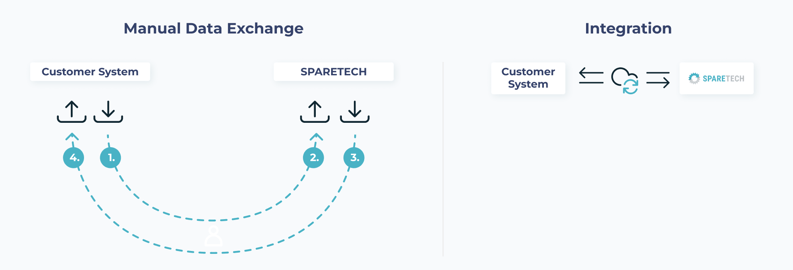
Manual data exchange in four steps.
- Export of the material master from the customer's ERP or MDG
- Upload to SPARETECH
- Export from SPARETECH in a structured and customized format
- Upload to MDG via Master Data Governance Consolidation App
API Interface
With the API interface, the data can be retrieved and synchronized automatically. Retrieval of the creation and change requests from SPARETECH are thus automatically transferred to SAP, so that the approval or rejection of the requests can take place via MDG.

This is an indicative visualization of the data exchange between SPARETECH and MDG. Please note that the process may vary depending on the customer's specific setup.
Your ERP stays the source of truth, SPARETECH makes the data behind it trustworthy
- Synchronize data [SPARETECH; MDG]: Export spare parts lists from MDG or ERP and upload them to SPARETECH.
- Identify need [SPARETECH]: Find a spare part in a few seconds via our global material search
- Manage spare parts in SPARETECH [SPARETECH]:
a. Create a new spare part, extend it to a new plant or modify an existing one using data from our database
b. Transfer new spare part creation, extension or modification directly to your ERP system via API or import. - Retrieve data [MDG] (new creation, extension and change intentions) from SPARETECH with pre-filled fields.
- Validate & Activate Material [MDG, ERP, SPARETECH]:
a. Approve material in MDG
b. Submit material in MDG
c. Synchronization with other systems
If you want to optimize your spare parts data management, do not hesitate to contact us. We will be happy to help you and answer all your questions.